
Stories & Research Insights
By Pascal Groboillot, Henckell Genealogical Research
You have found your ancestor’s birthplace on a ship manifest or a naturalization paper. You type the name into a map, and nothing comes up. Or worse, you find a village in the wrong country.
If you’re tracing roots in Alsace, Germany or Switzerland, try looking for another form of the name. The spelling in your record may reflect a different language or an earlier administration.
Why one village can have two names
In the Rhine region, borders and languages have shifted many times. Alsace was part of France before the 1871 Treaty of Frankfurt transferred most of the region to the German Empire. It returned to French administration in 1918. During the Second World War, Nazi Germany annexed Alsace de facto in 1940, and French administration was restored as the region was liberated in 1944–45.
Civil records, maps and official documents could carry different forms of the same place name. During the German imperial period, Alsatian civil registers were kept in German. You can also encounter German in earlier Alsatian records.
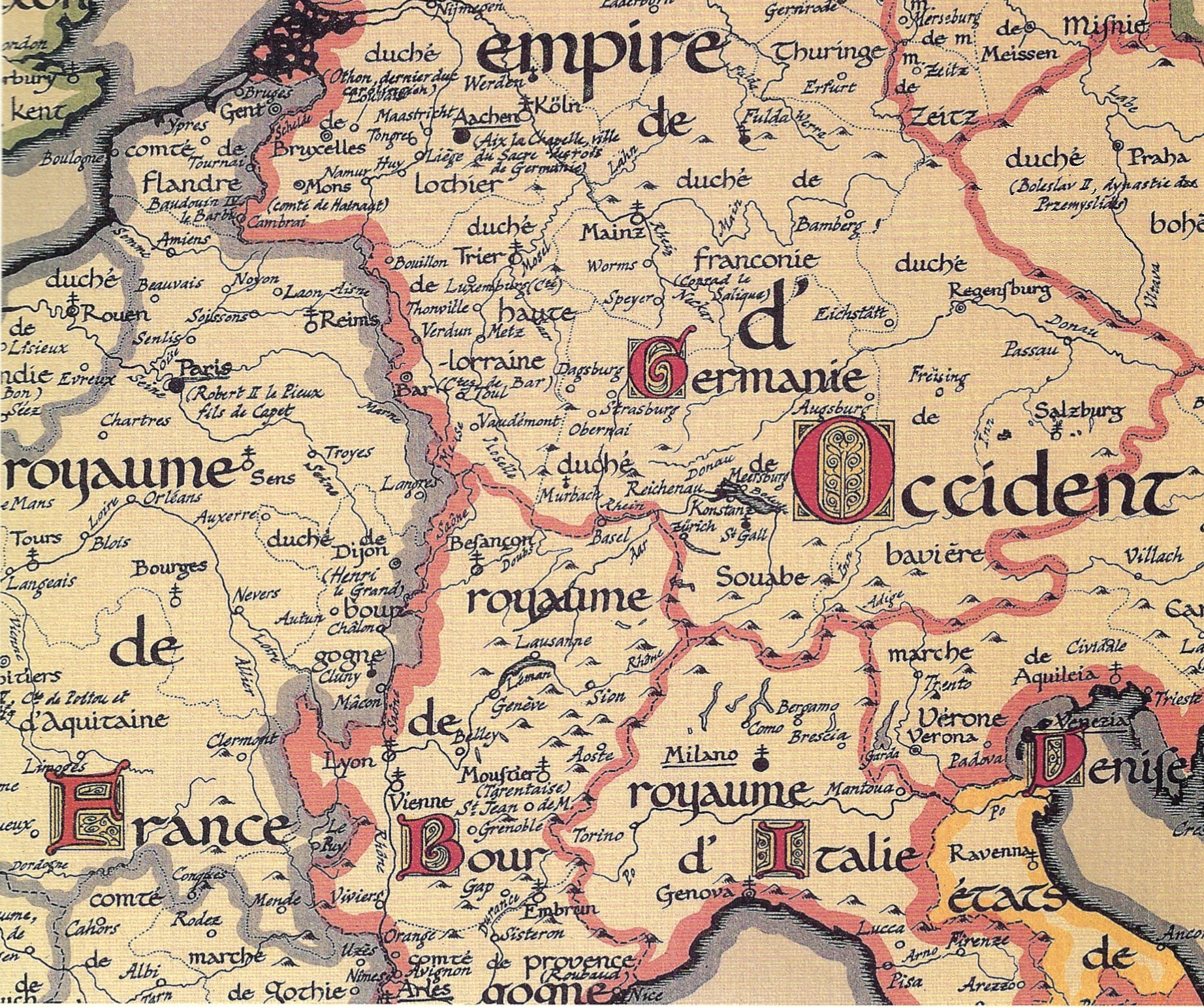
A few examples
In Alsace
- Strasbourg / Straßburg
- Mulhouse / Mülhausen
- Sélestat / Schlettstadt
- Saverne / Zabern
- Haguenau / Hagenau
- Wissembourg / Weißenburg
Around the Rhine and Lake Constance
- Lake Constance / Bodensee
- Constance / Konstanz
- Basel / Bâle / Basle
- Geneva / Genève / Genf
- Lucerne / Luzern
Be careful with names that look alike. Freiburg may refer to Freiburg im Breisgau in Germany or to Fribourg in Switzerland. Look for a neighboring town, canton or district before deciding which place the record means.
The same problem with people’s names
First names and surnames vary too. A Jean in a French record may appear as Johann or Hans in a German-language one. A surname may appear as Schmitt, Schmidt or Schmid. Compare other details in the records before treating two spellings as the same person.
What American records can hide
US documents may give only a country or region. The same Alsatian birthplace may appear as “France,” “Germany” or “Alsace,” depending on the date and the way the information was reported or recorded. Compare records from different points in your ancestor’s life.
A personal example
My own family name comes from an ancestor, Romanus, born in 1711 in Stockach, near Lake Constance, the Bodensee in German. He later came to operate a tile works in Menoncourt, near Belfort, in eastern France. Following his story meant moving between languages, spellings and countries.
Practical tips
- Write down every spelling you find, for people and places.
- Note the date of each document to work out which administration was in charge.
- Search both French and German forms of the place name.
- Compare historical gazetteers and maps with modern ones.
- Check nearby villages. A parish or registry office often served several communities.
- Compare the birthplace across several American records.
Need help finding the right village?
If you have a surname, a rough date and a place name that does not seem to exist, I can help you work out where your family came from. I am based in Mulhouse, Alsace, and I read original records in French and German.
Request a free initial assessment at henckellgenealogy.com.
Sources and research tools
- Archives d’Alsace, Précisions historiques, for administrative changes and the languages of the records.
- Meyers Gazetteer, for historical place names and maps of the German Empire.
- Romanus, Stockach and Menoncourt: the author’s family research.